Short answer: An Indian B2B seller usually needs only four pipeline stages: New, Qualified, Proposition and Won, with Lost recorded as a reason rather than a stage. Write one exit rule for each stage, so everyone moves a deal for the same reason. Then assign leads by rule, put a quotation on every deal in Proposition, and review deals that sit too long in one stage.
This guide covers why pipelines drift, which stages to use, how to set them up, and how Sales Automation Suite handles it.
Why do sales pipelines stop meaning anything?
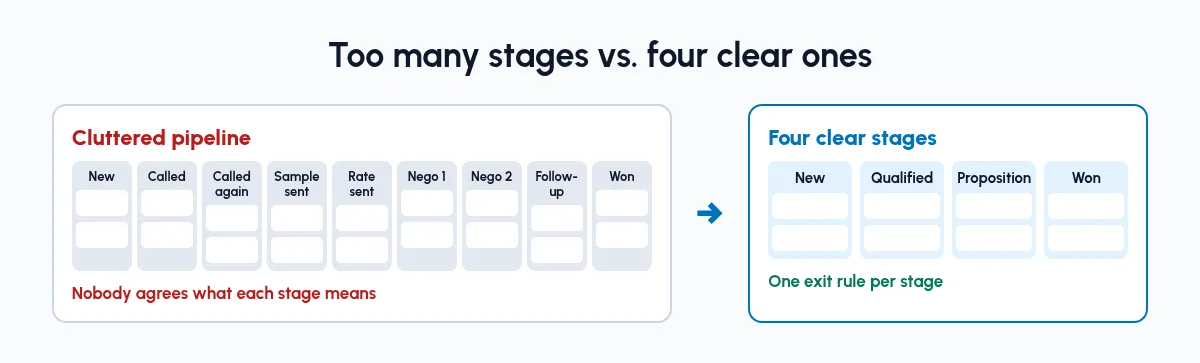
Too many stages blur what each one means. Four clear stages stay readable.
Many Indian B2B teams start with a pipeline, then stop trusting it within a few months. The usual reasons:
Too many stages. "Called", "Called again", "Sample sent", "Rate sent", "Negotiation 1"… Nobody remembers the difference, so deals sit wherever they were last dragged.
No exit rules. One salesperson moves a lead to Qualified after one call. Another waits for a site visit. The same stage means different things.
Every portal enquiry is treated as a deal. IndiaMART, TradeIndia and JustDial enquiries pour into the first stage, and real buyers drown among students and price-checkers.
Lost deals are deleted, not recorded. Without a lost reason, the team cannot see why buyers walk away.
Quotes live outside the pipeline. The rate goes out on WhatsApp or email, and the pipeline never shows what was actually offered.
Which pipeline stages should an Indian B2B seller use?
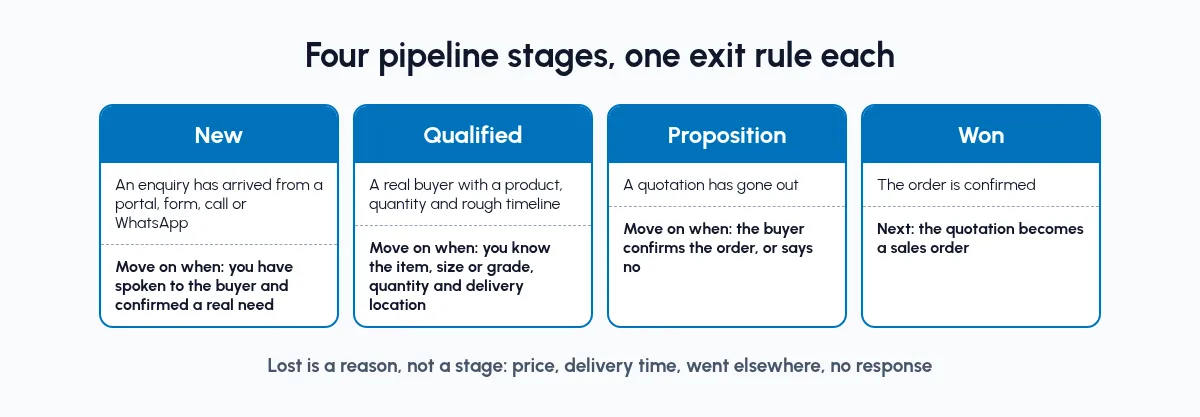
Four stages, one exit rule each. Lost is a reason, not a stage.
Keep it to four stages, each with one clear exit rule.
New: An enquiry has arrived from a portal, form, call or WhatsApp. Move on when: the salesperson has spoken to the buyer and confirmed a real need.
Qualified: A real buyer with a product, quantity and rough timeline. Move on when: you know what to quote: item, size or grade, quantity and delivery location.
Proposition: A quotation has gone out. Move on when: the buyer confirms the order, or says no.
Won: The order is confirmed. Move on when: the quotation becomes a sales order.
Lost is not a fifth stage. When a buyer says no, mark the deal lost with a reason such as price, delivery time, went elsewhere or no response. Those reasons are worth more than the stage count.
Samples, site visits and negotiation calls are activities inside a stage, not stages of their own. That keeps the pipeline short enough to read at a glance.
How do I set up sales pipeline stages in a CRM?
Step 1: Agree the stages and exit rules on paper
Before you open the CRM, write the four stages and their exit rules on one page and share it with every salesperson. If the team does not agree what Qualified means, the software will not fix it.
Step 2: Rename or merge the stages in the CRM
Set the pipeline to New, Qualified, Proposition and Won. If your current pipeline has extra stages, move their deals into the nearest of the four before you remove them.
Step 3: Set up lost reasons
Create a short list of lost reasons that match your trade: price, delivery time, design or grade not available, went elsewhere, no response. Ask for one every time a deal is marked lost.
Step 4: Route new leads by rule
Portal enquiries should reach the right salesperson without someone forwarding them. Set assignment rules by area, product or source, so every New lead has an owner the day it arrives. Our guide to IndiaMART CRM integration covers getting portal leads in.
Step 5: Quote from the deal, not from a sheet
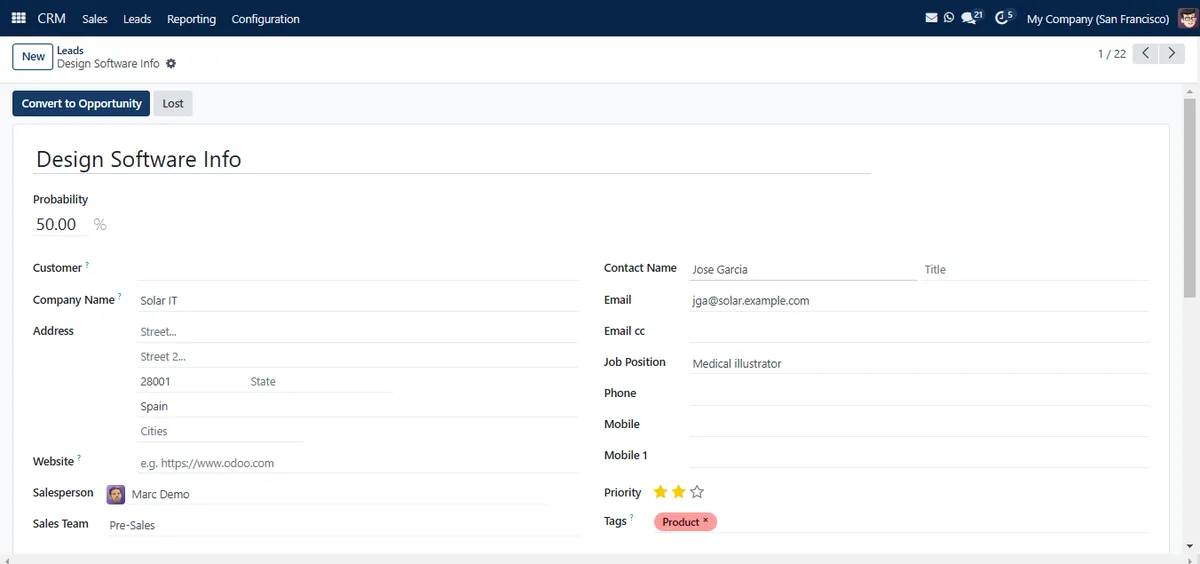
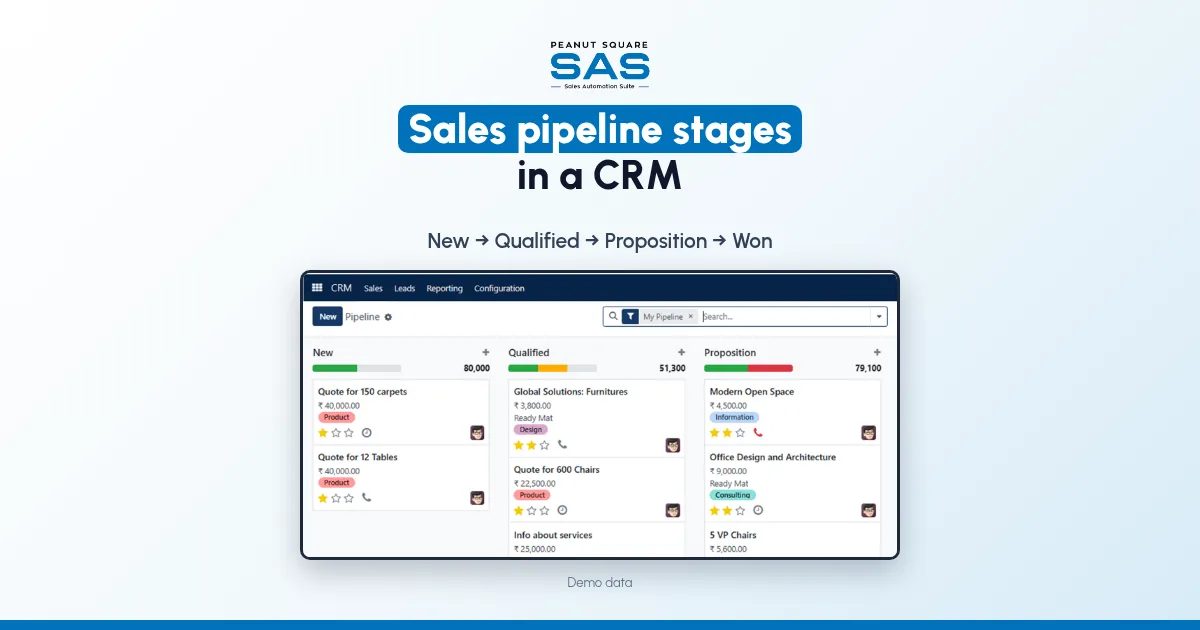
Work the deal from its record in SAS CRM. Demo data.
When a deal reaches Proposition, create the quotation from the opportunity itself, so the pipeline shows exactly what was offered and when. If quotes need to match stock, see inventory and sales integration.
Step 6: Review stuck deals every week
Look at deals that have sat in one stage longer than your normal sales cycle. Either schedule the next activity or mark them lost with a reason.
What does this look like for a tile maker or trader?
For a ceramic tile business, the stages map neatly onto how tiles are sold:
New: a dealer or project buyer enquires on IndiaMART or WhatsApp about a size or design.
Qualified: you know the design, size, quantity in boxes and the delivery state.
Proposition: a quotation goes out after checking whether the design is ready, half-ready or not ready.
Won: the dealer confirms and the order moves to dispatch.
Our page on CRM and ERP for tile manufacturers and traders covers the tile-specific modules, and CRM software for Morbi covers the Morbi enquiry-to-dispatch flow.
What changes once the stages are clear?
We will not put a percentage on it. These are changes you can check in the first few weeks:
Every salesperson moves deals for the same reasons.
Every new enquiry has an owner.
Every deal in Proposition has a quotation attached.
Lost deals carry a reason you can count.
The sales head can see which deals are stuck, and where.
How does Sales Automation Suite handle pipeline stages?
Sales Automation Suite (SAS) from Peanut Square is one ERP and CRM built for how India sells. It is meant for India B2B sellers who outgrow a CRM-only stack and want one INR-priced ERP+CRM with India lead portals and WhatsApp on the pricing page, on Cloud or On-Premise.
The SAS knowledge base (checked 15 Oct 2026) describes the pipeline:
Opportunities sit in My Pipeline under New, Qualified, Proposition and Won, and a new stage can be added from the pipeline view (create an opportunity from a lead).
A quotation can be started from an opportunity in the Proposition stage, and the time an opportunity has spent in a stage is shown (create a quotation in CRM).
Lost reasons are set up under Configuration, and a reason is chosen when an opportunity is marked lost (add lost reasons).
Rule-based assignment routes leads to sales teams and salespeople by conditions you set, either manually or on a repeating schedule (rule-based assignment).
According to the SAS pricing page (checked 15 Oct 2026), IndiaMART, TradeIndia, JustDial, Meta forms and Free WhatsApp Automation are listed as integrations on the plan, so portal enquiries can start in New. SAS is certified to ISO 9001:2015 and ISO 27001:2022.
On price: ₹300 per user per month on Premium, after a listed 40% off ₹500. GST extra, billed yearly, and the discount is valid for 12 months for the initial users ordered. Source: SAS pricing, checked 15 Oct 2026.
Which pipeline stages should an Indian B2B seller use?
Four: New, Qualified, Proposition and Won. Record lost deals with a reason instead of a separate stage.
How many stages should a sales pipeline have?
As few as your team can agree on. Four stages with clear exit rules are easier to keep honest than eight that overlap.
Should samples and site visits be pipeline stages?
No. They are activities inside a stage. Keep them as scheduled activities so the pipeline stays short.
Why record a lost reason?
Lost reasons show why buyers walk away, such as price or delivery time, so you can fix the cause rather than guess.
How do portal leads reach the right salesperson?
Use rule-based assignment by area, product or source, so each new enquiry has an owner the day it arrives.