Short answer: Tile production planning should start from confirmed dealer orders, not last month's sales. Each week, list shortage by design, size and grade, which is confirmed order quantity that stock cannot cover, sort it by order age and the planning dates promised to dealers, and plan the kiln and line around that. Check old unbooked stock too, so sales can offer it before the plant makes more of the same design.
Morbi factories run lines that cannot change design every hour, so the plan matters. This guide covers the inputs, a weekly routine and how SAS supports it. For stock basics, see ceramic stock management for tile factories.
Why does tile production planning miss dealer orders?
Plans are often made from past sales and whoever called loudest. Confirmed orders for slow designs wait, while fast designs are over-made.
Shortage is not visible by design and grade.
Planning dates given to dealers are not on the order.
Old stock of a design is not seen before more is made.
What should a tile production plan be based on?
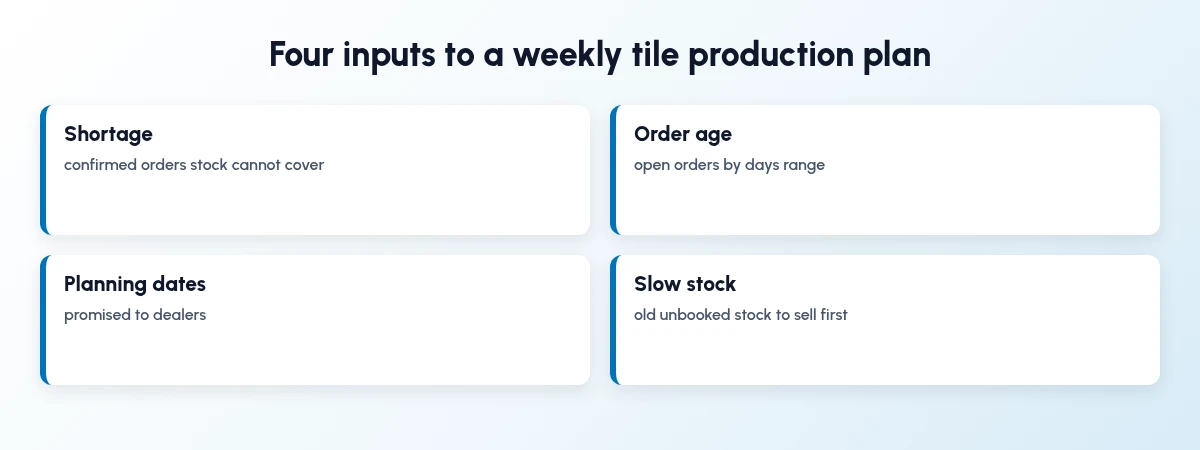
Four inputs, read together.
Shortage by design, size and grade.
Order age: open orders by days range, oldest first.
Planning dates promised to dealers.
Slow stock: unbooked stock sitting for months.
How should a weekly tile production planning meeting run?
Keep it short, with the same people every week.
Read shortage by design and grade (planning): list of designs to make.
Check order age and planning dates (sales): which orders are urgent.
Check slow stock (sales): designs to offer first.
Fit to lines and kilns (plant): weekly plan.
Update planning dates (planning): dates told to dealers.
How do planning dates reach the dealer?
Put the planning date on each not-ready order, and tell the dealer the same day. When the plan changes, change the date on the order first, then tell the dealer.
How does Sales Automation Suite support tile production planning?
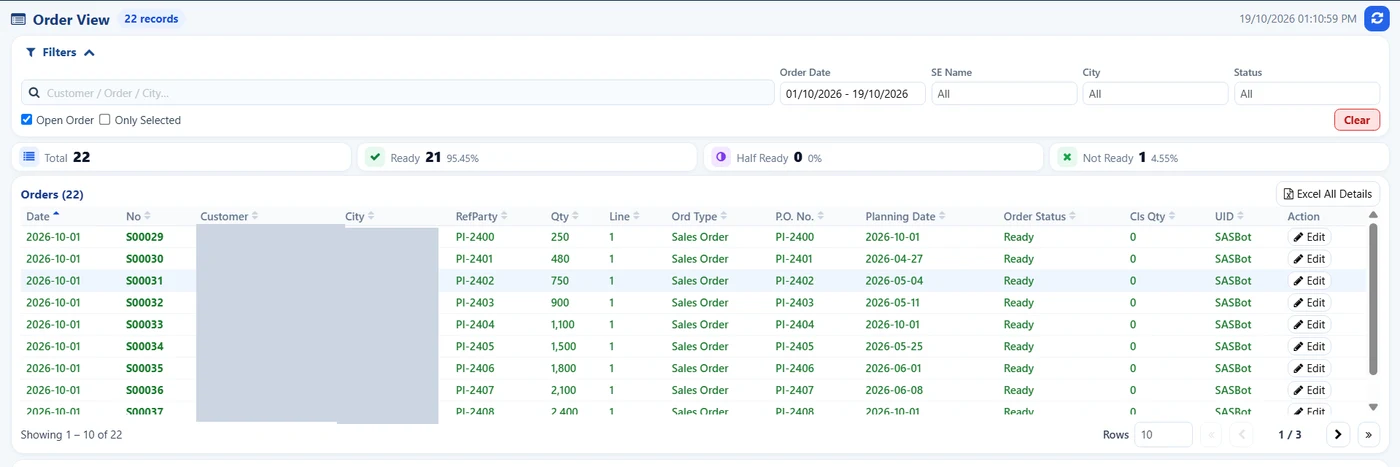
SAS Order View: open orders with planning date and status. Customer names and cities hidden.
Sales Automation Suite (SAS) from Peanut Square is one ERP and CRM built for how India sells. It is meant for Indian B2B sellers who outgrow a CRM-only stack: India lead portals and WhatsApp are on the pricing page, the price is in rupees, and it runs on Cloud or On-Premise.
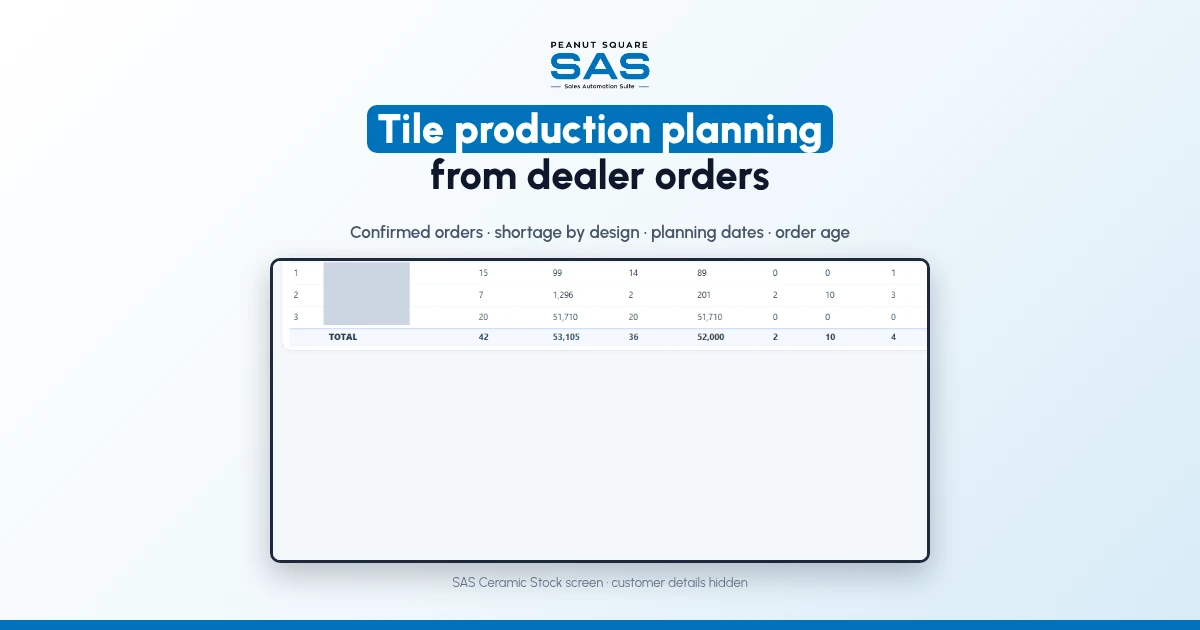
In the SAS Ceramic Stock screens shared by Nishant Patel on 19 Oct 2026 (customer details hidden), the Order View lists open orders with city, planning date and order status, and counts ready, half-ready and not-ready orders. The Ceramic Stock Dashboard shows an open order summary by days range and a Stock Summary by days range with stock, booking, after booking and shortage.
The SAS pricing page lists Production Jobs, MRP, WIP Stage Movement, Purchase Planning and Rejection Analysis. The SAS tile industry page lists SAS Ceramic Stock Management. Our guides on tile order status tracking and tile stock visibility for dealers cover the dealer side. For the wider Morbi flow, read ERP and CRM for Morbi tile factories.
On price: ₹300/user/month on Premium (40% off ₹500, GST extra, billed yearly).
SAS is built by Peanut Square in Ahmedabad, Gujarat. The SAS tile industry page lists ISO 9001:2015 and ISO 27001:2022.
To see it with your own process: Book a free demo at sas.peanutsquare.com
How should a tile factory plan production from dealer orders?
List shortage by design, size and grade from confirmed orders, sort by order age and planning dates, check slow stock, and fit the result to lines and kilns every week.
What is shortage in tile production planning?
Confirmed order quantity that current stock cannot cover. It is the clearest list of what to make next.
Why look at old stock before planning?
Old unbooked stock of a design can fill new orders. Offer it first instead of making more.
How often should a tile factory plan production?
Weekly is a simple rhythm to start with, with a short daily check for urgent orders.
Does SAS have production planning for tile factories?
The SAS pricing page lists Production Jobs, MRP, WIP Stage Movement and Purchase Planning. Ask SAS how they connect to Ceramic Stock for your plant.