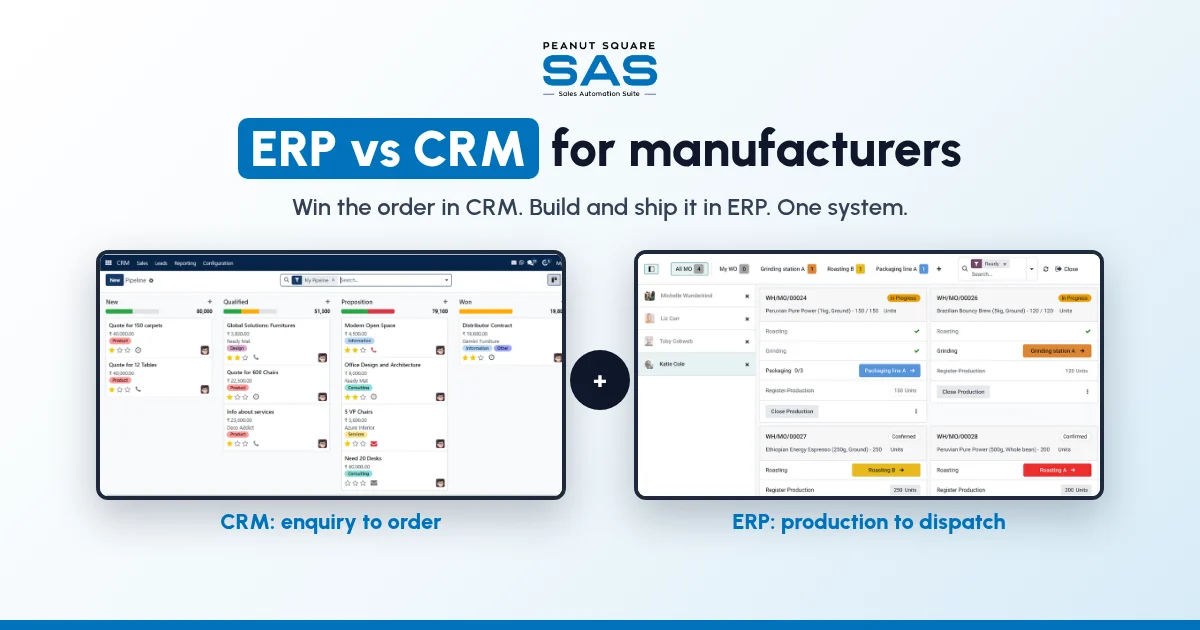
Short answer: ERP vs CRM for manufacturers comes down to two halves of one job. A CRM tracks enquiries, follow-ups and quotations until the buyer says yes. An ERP plans materials, production, stock, purchase and billing after that. Most Indian B2B manufacturers need both, joined, so the sales order reaches the shop floor without retyping.
This guide to ERP vs CRM for manufacturers covers what each system does, where the handoff breaks, how to decide, and how Sales Automation Suite covers both.
What is the difference between ERP and CRM for a manufacturer?
A CRM (customer relationship management system) faces the buyer. It holds leads, contacts, conversations, follow-ups and the sales pipeline. Its job ends when an enquiry becomes a confirmed order. Wikipedia's CRM entry describes it as a process organisations use to manage, analyse and improve their interactions with customers.
An ERP (enterprise resource planning system) faces the factory and the books. It holds bills of materials, purchase orders, stock in each store, production jobs and accounts. Its job starts when there is something to make, buy or bill. Wikipedia's ERP entry describes it as integrated management of main business processes.
A trader can run on a CRM plus billing for a long time. A manufacturer usually cannot. What sales promises — a price, a quantity, a delivery date — depends on raw material, machine time and finished stock. That is ERP data. So the CRM and the ERP have to talk, or the salesperson is promising blind. That is why ERP vs CRM for manufacturers is less an either-or choice than a question of how the two connect.
What does a CRM do for a manufacturer?
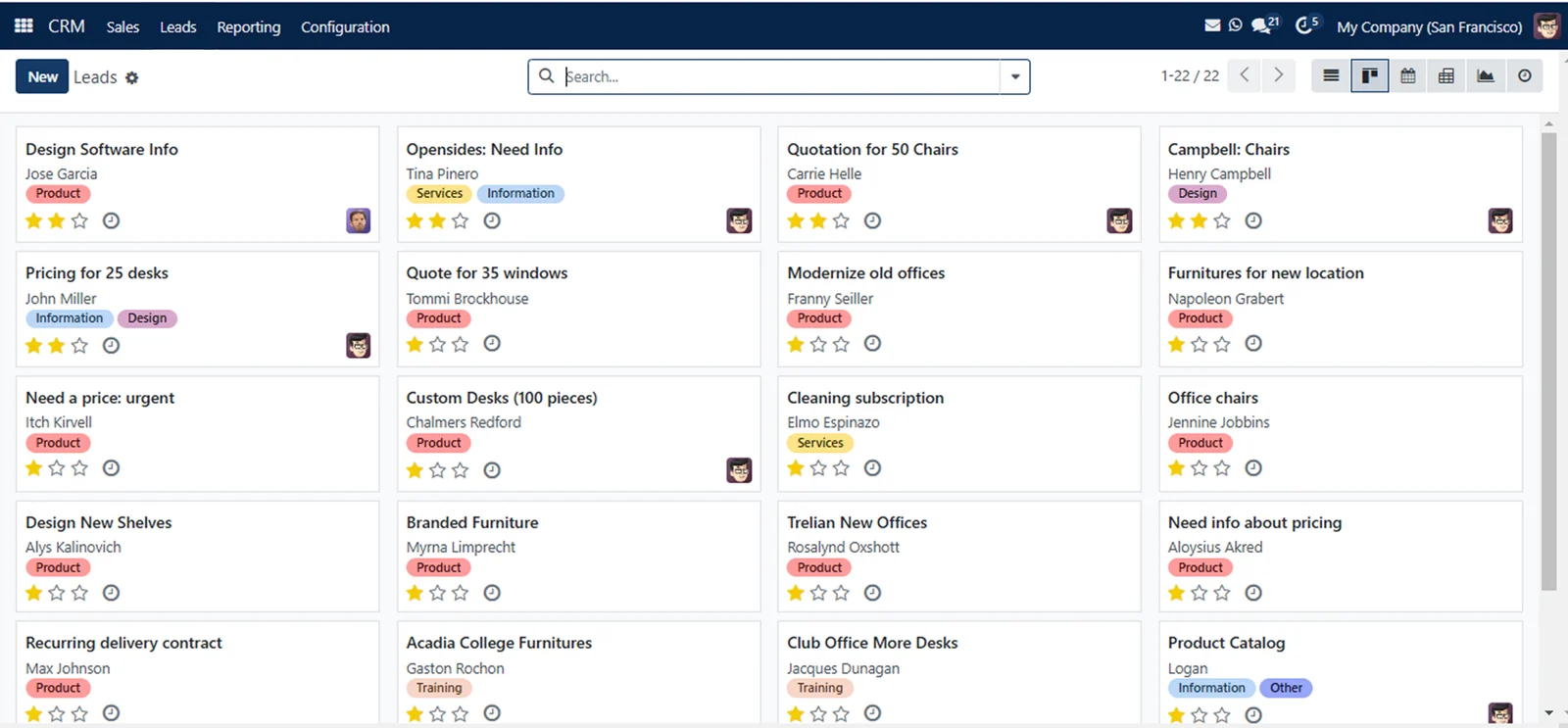
A manufacturer's leads rarely arrive in one place. They come from IndiaMART, TradeIndia, JustDial, Meta lead forms, WhatsApp, dealers and walk-ins. A good manufacturing CRM covers:
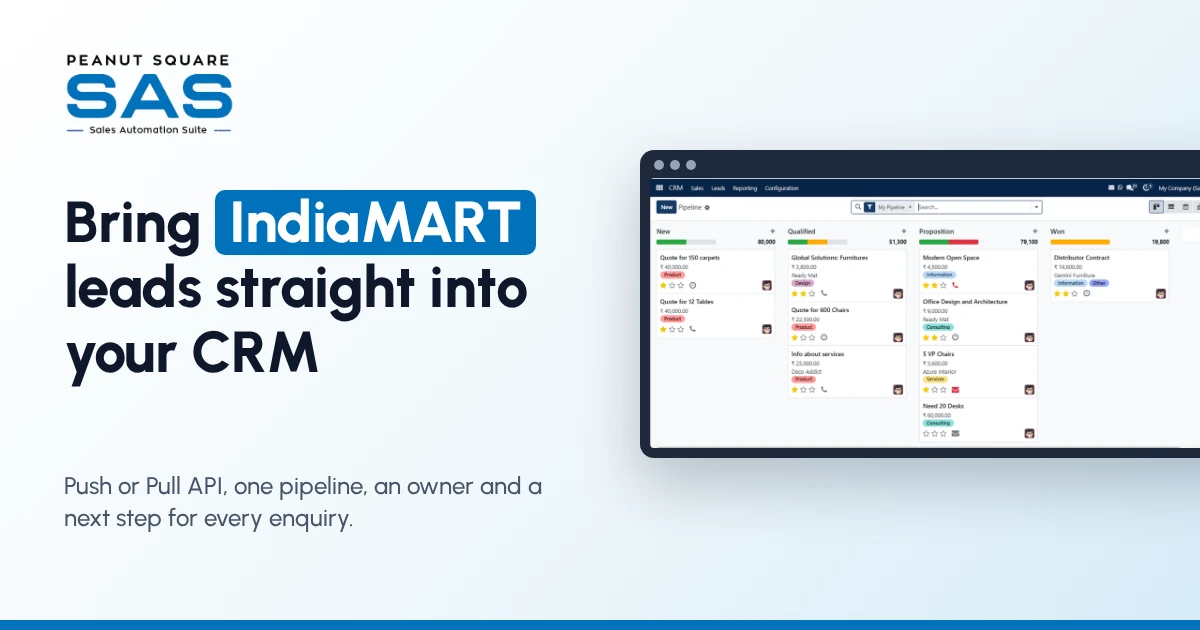
Lead capture from every source. Portal and ad-form leads land in one list, each with a named owner. Our guide on IndiaMART CRM integration walks through the portal side.
Assignment. Leads go to a salesperson by rules you set, not by whoever opens the portal first.
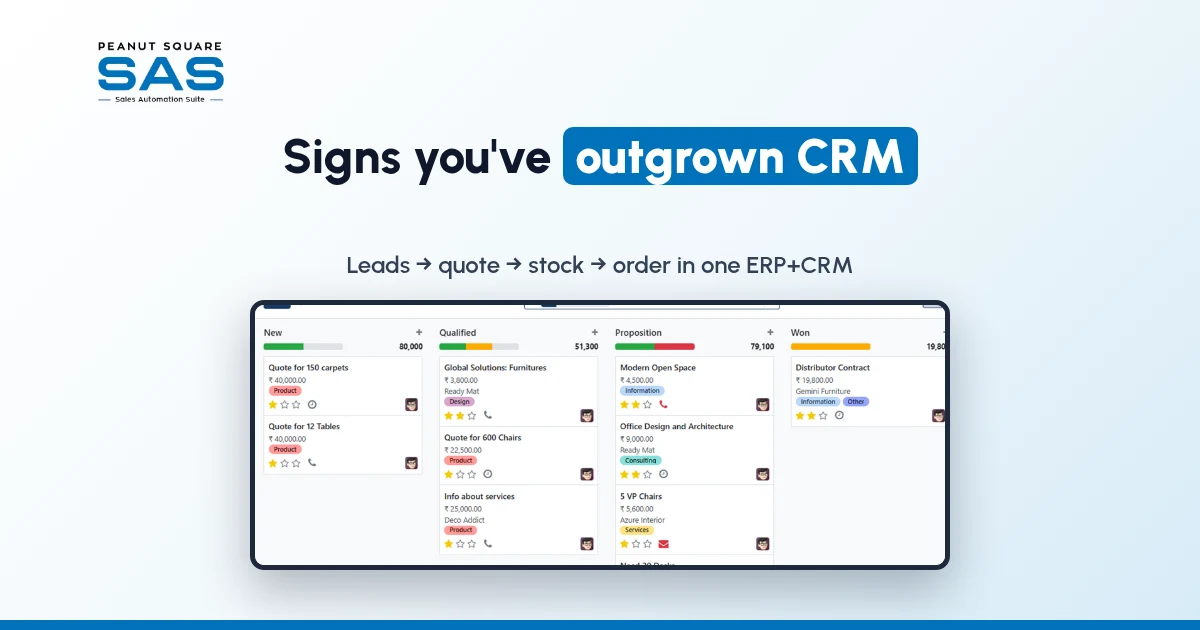
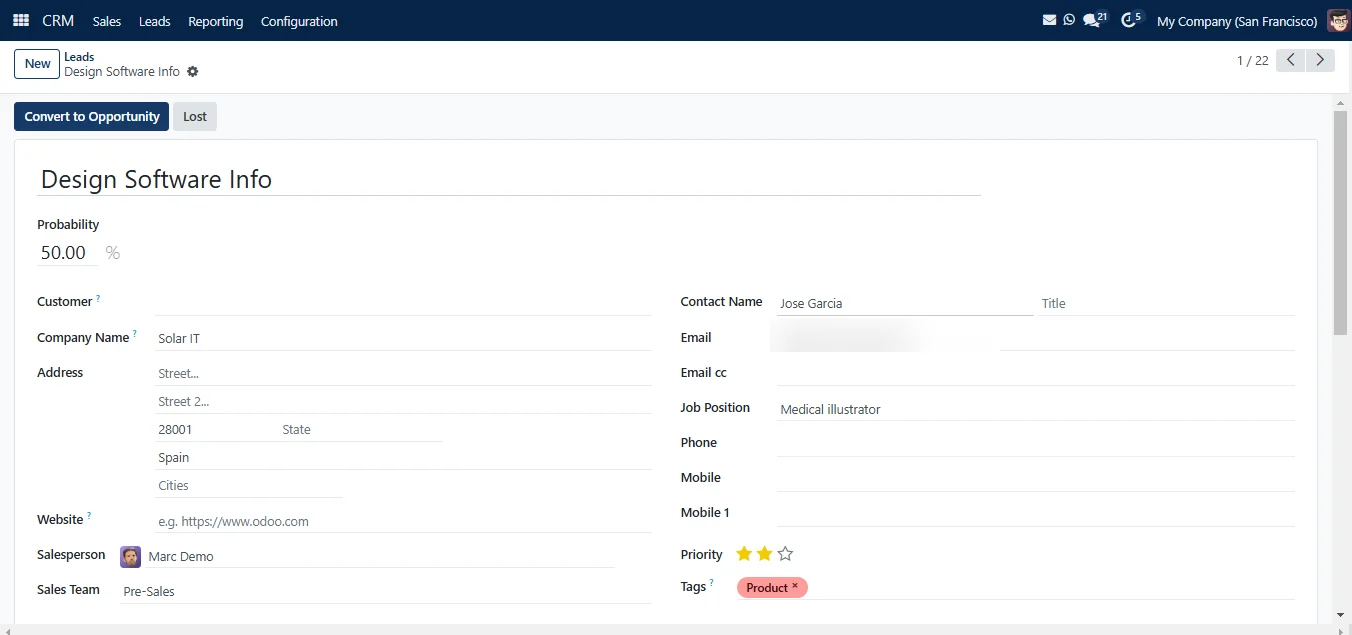
A clear pipeline. In Sales Automation Suite the stages are New, Qualified, Proposition and Won, so everyone reads the same funnel.
Follow-ups and conversation history. Calls, visits and WhatsApp messages sit on the lead, not on one person's phone. See WhatsApp CRM automation for how follow-ups can run from the CRM.
Quotations. The quote is made from the opportunity, so the price and product lines are tied to the buyer who asked for them.
What a CRM alone does not know: whether you have the raw material, how long the job takes on the floor, or whether last month's invoice was paid.
What does an ERP do for a manufacturer?
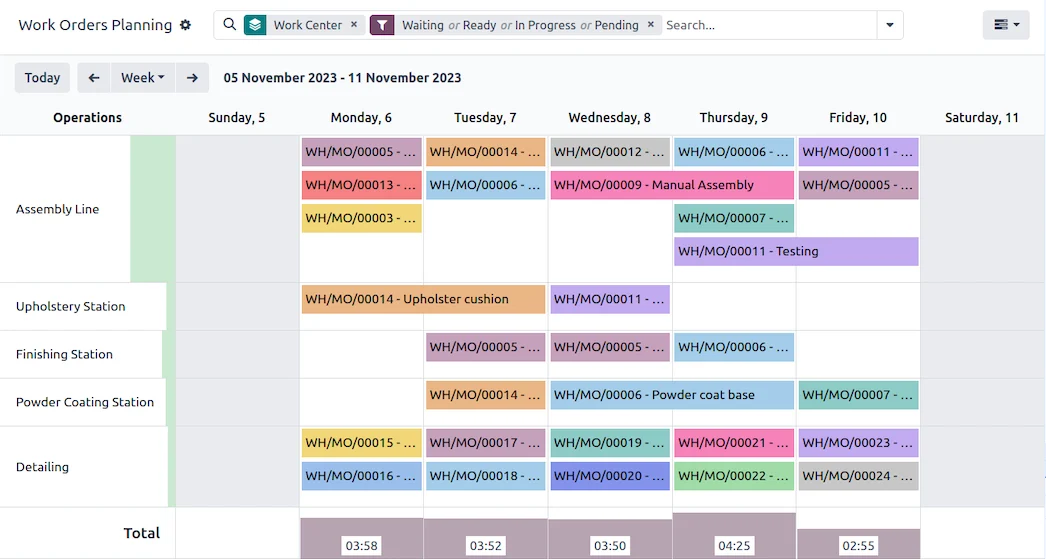
An ERP covers the work after the order. For a manufacturer that usually means:
Bill of materials (BOM). What goes into each finished product, and in what quantity.
Material planning (MRP). What to buy or make, and when, based on orders and stock in hand.
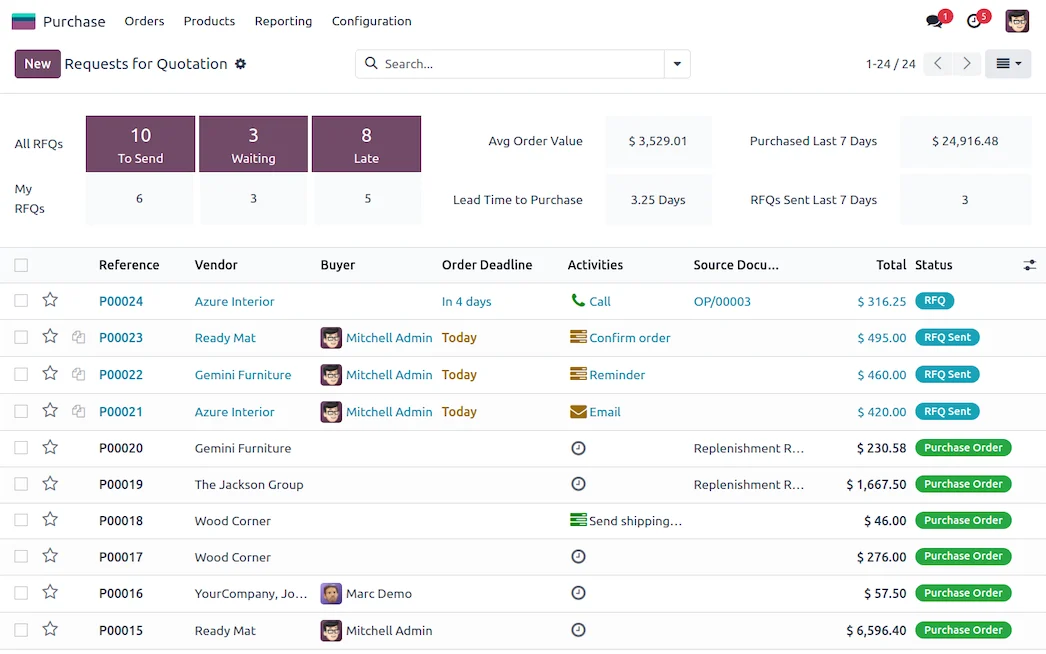
Purchase. Requests for quotation, purchase orders and goods receipt (GRN) against them.
Inventory. Stock by store, batch and expiry, minimum levels and reorder rules.
Production. Production jobs, work-in-progress by stage, material consumption and rejections.
Accounting. Ledgers, vouchers, sales and purchase billing, P&L and balance sheet.
What an ERP alone does not know: where the order came from, who owns the buyer, or which lead source produces paying customers.
ERP vs CRM for manufacturers: side by side
Who uses it most? CRM: Sales team, sales head. ERP: Production, stores, purchase, accounts.
Where does the record start? CRM: An enquiry or lead. ERP: A sales order, BOM or purchase need.
India lead portals and WhatsApp CRM: Core job. ERP: Not its job.
Quotations CRM: Yes, from the opportunity. ERP: Sometimes, often re-entered.
Stock and batches CRM: Usually not. ERP: Core job.
BOM, MRP and production jobs CRM: No. ERP: Core job.
Purchase and GRN CRM: No. ERP: Core job.
Billing and ledgers CRM: Usually not. ERP: Core job.
Can it tell you which lead source produced paid orders? CRM: Only if the order links back. ERP: Only if the lead links forward.
Each system answers half the last question. Joined, they answer all of it.
Where do ERP and CRM meet on the shop floor?
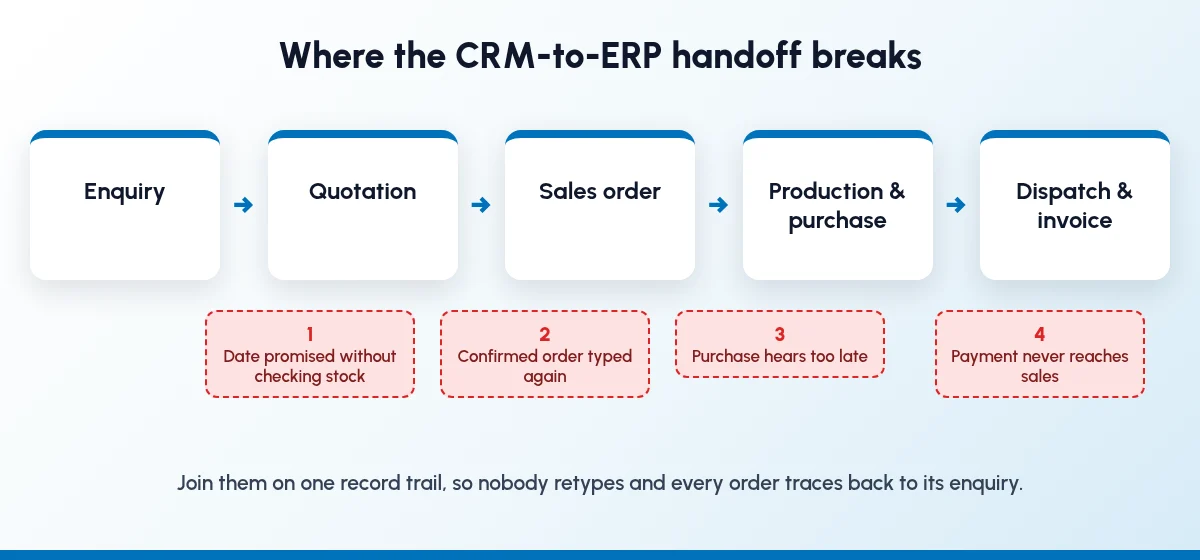
The trouble in most factories is not the CRM or the ERP on its own. It is the handoff between them. Four points break most often.
1. The quote promises a date nobody checked
A salesperson quotes the usual lead time because that is what they quoted last time. Raw material is short, or the line is booked. If the quote cannot see stock and planned production, the promise is a guess.
2. The confirmed order is typed again
The buyer accepts the quotation. Someone re-enters it as a sales order in the ERP, or emails a PDF to production. Every retype is a chance to change a quantity, a size or a price.
3. Purchase hears about the order too late
If the sales order does not feed material planning, purchase finds out when stores run out, and the job waits on a supplier who could have been called earlier.
4. Dispatch and payment never reach the salesperson
The invoice goes out from the ERP. The CRM still shows Won with no idea whether payment came in, so repeat-order follow-ups start from a stale picture.
If two or more sound familiar, you have a joining problem, not a software-shopping problem. We cover the wider version in signs your business has outgrown a CRM-only tool.
Do manufacturers need an ERP, a CRM, or both?
The honest answer to ERP vs CRM for manufacturers depends on where your bottleneck sits. Use the sell motion to decide, not a feature list.
Start with CRM if your biggest pain is lost or slow enquiries: portal leads unanswered, no clear owner, follow-ups on personal phones. Production is simple, made to stock, and stock is easy to see.
Start with ERP if sales is steady and repeat-driven but the floor is the bottleneck: material shortages, unclear BOM costs, WIP you cannot see, stock that never matches the books.
Plan for both, joined, if you make to order, quote custom sizes or specs, take leads from several India portals, and promise delivery dates that depend on material and machine time. That describes many Indian B2B manufacturers.
Joined does not mean everything on day one. It means the lead, quotation, sales order, production job and invoice share one record trail, so nobody retypes and reports can follow an order back to its enquiry.
How do you join ERP and CRM without a big-bang rollout?
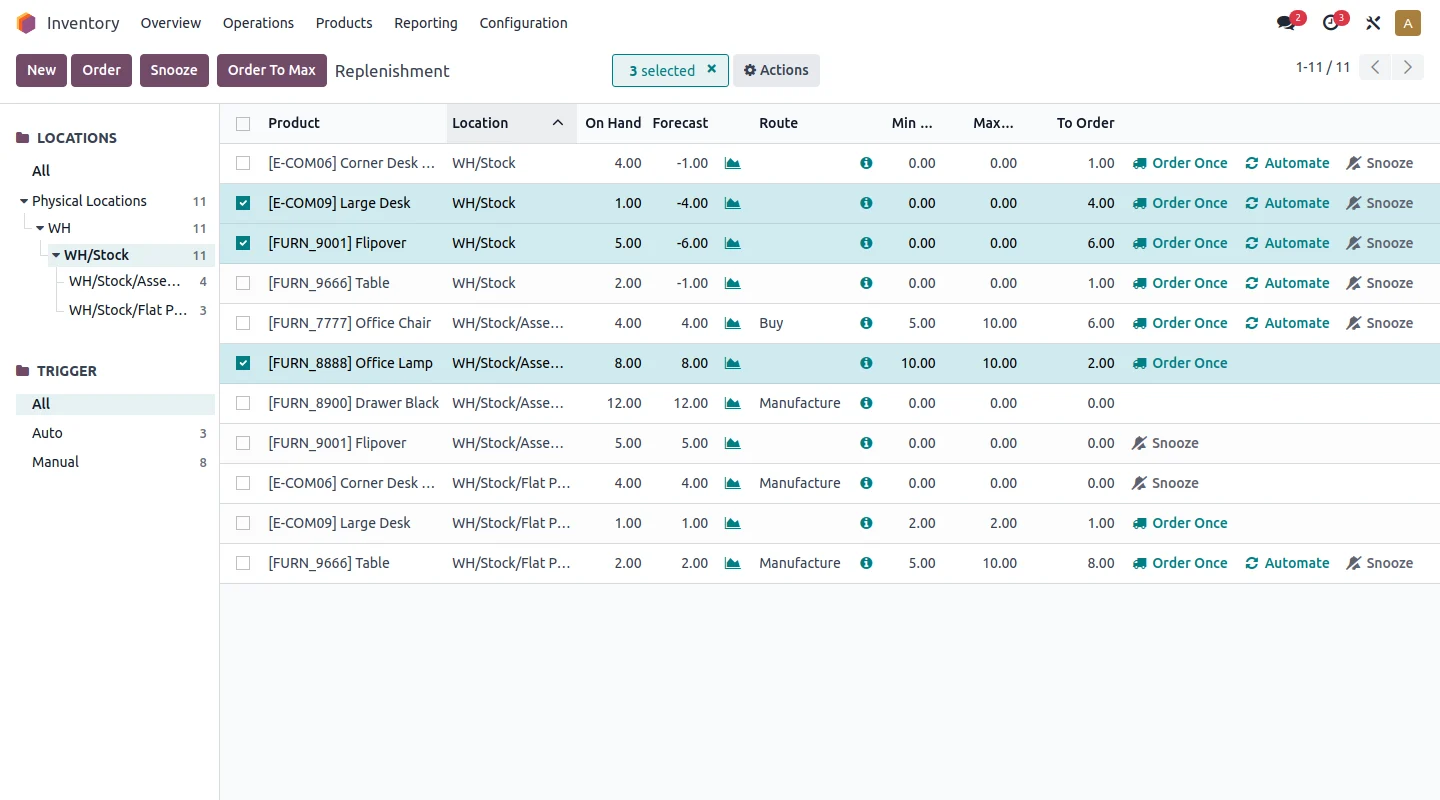
Move in the order the work flows.
Leads into one pipeline. Connect your portals, ad forms and WhatsApp, and turn on assignment so every lead has an owner. SAS documents this in its rule-based assignment guide (checked 14 Oct 2026).
Quotations from the opportunity. Stop building quotes in a spreadsheet. The SAS knowledge base shows quotes being created from an opportunity in the Proposition stage (how to create a quotation in CRM, checked 14 Oct 2026).
Stock and products cleaned up. Set up products, stores and minimum levels so quotes can be checked against real stock.
Sales order to production and purchase. Confirm the quotation into a sales order, then let material planning tell purchase and production what is needed.
Billing and payment back to the account. Invoice from the same order so sales can see what shipped and what is still due.
How does Sales Automation Suite handle ERP and CRM for manufacturers?
Sales Automation Suite (SAS) from Peanut Square is one ERP and CRM built for how Indian B2B businesses sell. The fit: India B2B sellers who outgrow a CRM-only stack get one INR-priced ERP+CRM with India lead portals and WhatsApp on the pricing page — Cloud or On-Premise.
According to the SAS pricing page (checked 14 Oct 2026), one plan lists:
CRM and sales: Lead Import, Funnel, Assignment, Interactions, Follow-ups, Visit Geo-Tag, Quotations, Proforma Invoices, Sales Orders and Billing.
Operations: Inventory with Multiple Stores, Batches, Expiry and Min levels; BOM; Purchase Planning, Purchase Orders and GRN; Material Issue and Stock Reconciliation; Production Jobs, MRP, WIP Stage Movement, Consumption, Stock Availability, Rejection Analysis and Backflush.
Accounting: Balance Sheet, P&L, Trial Balance, Vouchers and Ledger.
Integrations: IndiaMART, TradeIndia, JustDial, Meta forms and Free WhatsApp Automation.
The SAS home page (checked 14 Oct 2026) says it connects "CRM, inventory, sales, manufacturing, and POS into a single unified workspace", describes manufacturing operations as covering "production planning, work orders, bills of materials", and offers Cloud or On-Premise deployment. The home page also states ISO 9001:2015 and ISO 27001:2022 certification. The SAS knowledge base describes a Run Scheduler for "automating your company's manufacturing and purchasing processes" and a replenishment tool with minimum and maximum quantities per product (both checked 14 Oct 2026).
On price: ₹300 per user per month on Premium, after a listed 40% off ₹500. GST extra, billed yearly, and the discount is valid for 12 months for the initial users ordered. Implementation is a separate one-time cost. Source: SAS pricing, checked 14 Oct 2026.
With both halves on one plan, you do not have to settle ERP vs CRM for manufacturers by buying and stitching two products. The pipeline stays the one your sales team already reads — New, Qualified, Proposition, Won — and the Won deal carries on into the quotation, sales order and invoice in the same system, with inventory, purchase and production on the same plan. See how SAS fits manufacturing businesses and what the SAS manufacturing app covers.
Do manufacturers need an ERP, a CRM, or both?
Most make-to-order manufacturers need both, joined. The CRM wins and tracks the order; the ERP plans material, production, stock and billing. If you only have one, the other half usually lives in spreadsheets and phone calls.
What is the main difference in ERP vs CRM for manufacturers?
A CRM looks outward at buyers and the sales pipeline. An ERP looks inward at materials, production, stock and accounts. The handoff point is the confirmed sales order.
Is ERP vs CRM for manufacturers a choice I have to make up front?
No. Roll out in the order the work flows: leads, quotations, stock, then production and purchase. You do not need every module live on day one.
Can India lead portals feed the same system as production?
Yes, if one product carries both. SAS lists IndiaMART, TradeIndia, JustDial, Meta forms and Free WhatsApp Automation on the same pricing page as BOM, MRP and Production Jobs (checked 14 Oct 2026).
Cloud or On-Premise for a factory ERP?
Choose for your data and connectivity needs. SAS offers both on its home page, and the Enterprise plan names On Premise with a one-time setup fee (checked 14 Oct 2026).