Quick answer: Tile manufacturing cost per square metre is the full cost of one batch, from body raw material, glaze, fuel and power to packing, labour and overheads, divided by the saleable square metres that batch produced. Record each cost against the batch and count rejects separately. Sales Automation Suite (SAS) keeps production jobs, consumption and batches in one record.
Most tile factories know their monthly gas bill and output. Fewer know what one batch of one design cost to make. A monthly average hides the batch with a kiln stoppage, the heavier glaze and the run with more seconds. This post shows which costs to record batch by batch, how to turn them into a cost per square metre, and why the figure moves from one batch to the next.
What goes into tile manufacturing cost per square metre?
Use the cost heads your plant already uses, so the shift team can fill them in:
Body raw material: clay, feldspar, quartz and any bought spray-dried powder, issued by weight.
Glaze, ink and engobe: the quantity issued to the line, less what came back.
Fuel: gas for the kiln and dryers, plus coal or lignite for the spray dryer where used.
Power: ball mills, presses, kiln drives, compressors and lighting.
Packing: boxes, pallets, strapping and labels.
Labour and overheads: shift wages, maintenance and plant overheads, shared by run hours.
Rejects and seconds: not a cost line, but the divisor changes with them.
Energy is a large share in ceramics. A Bureau of Energy Efficiency manual on the Morbi ceramic cluster, published in April 2010, put energy at about 25% to 30% of production cost. Fuel and power readings matter as much as material slips.
How do you work out cost per square metre for one batch?
Open a batch for one design, size and run, with a start date and time.
Issue material against that batch: body, glaze and packing, by quantity.
Take meter readings for gas and power at the start and end of the run.
Book run hours on the press and kiln, so labour and overheads can be shared.
Count output by grade: first grade, seconds you can sell, and rejects.
Add the costs and divide by the saleable square metres.
Convert to cost per box by multiplying by the square metres one box holds.
An example with round, made-up numbers: a batch costs ₹4,50,000 in total and gives 4,500 saleable square metres. That is ₹100 per square metre. If a box of four 600 × 600 mm tiles holds 1.44 square metres, the cost is ₹144 per box.
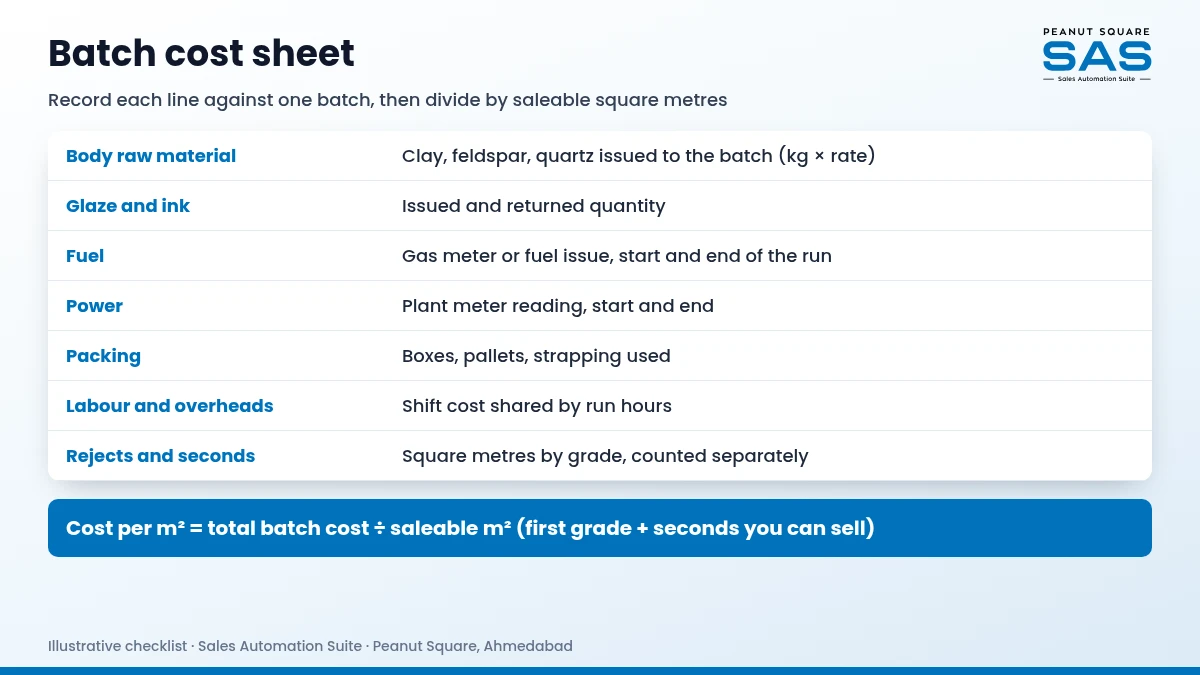
The cost heads to record against each batch, and the formula. Illustrative checklist.
How do you record fuel, power and raw material per batch?
The trick is to record at the batch boundary, not at the end of the month:
Fuel: read the gas flow meter when the first tile of the batch enters the kiln and when the last one leaves. If several designs share the kiln, share the gas by square metres fired.
Power: read the main meter, or section meters where you have them, at the same two points.
Raw material: issue body and glaze against the batch number, and book returns when the run ends.
Packing: count boxes and pallets used from the batch's own count, not from purchase totals.
A rough reading taken the same way every batch beats a perfect reading taken once.
Why does the cost per box differ between batches?
Grade mix: more seconds and rejects means fewer saleable square metres for the same spend.
Kiln stoppages: the kiln burns gas while it waits, and that gas lands on whichever batch is running.
Run length: short runs carry the full changeover cost on fewer square metres.
Glaze and design: heavier glaze or more passes on the printer use more material.
Fuel price: a gas price change mid-month shows up in every batch after it.
Size and thickness: a thicker body uses more powder and more firing per square metre.
What do factories get wrong when costing tiles?
The common mistakes are simple ones. Costs are averaged over a month, so a bad batch disappears. Rejects are left out of the count, so the cost looks lower than it is. Packing is booked from purchases instead of use. And the cost sheet lives in a spreadsheet that only one person updates, so nobody else trusts it.
How can an ERP help record batch costs?
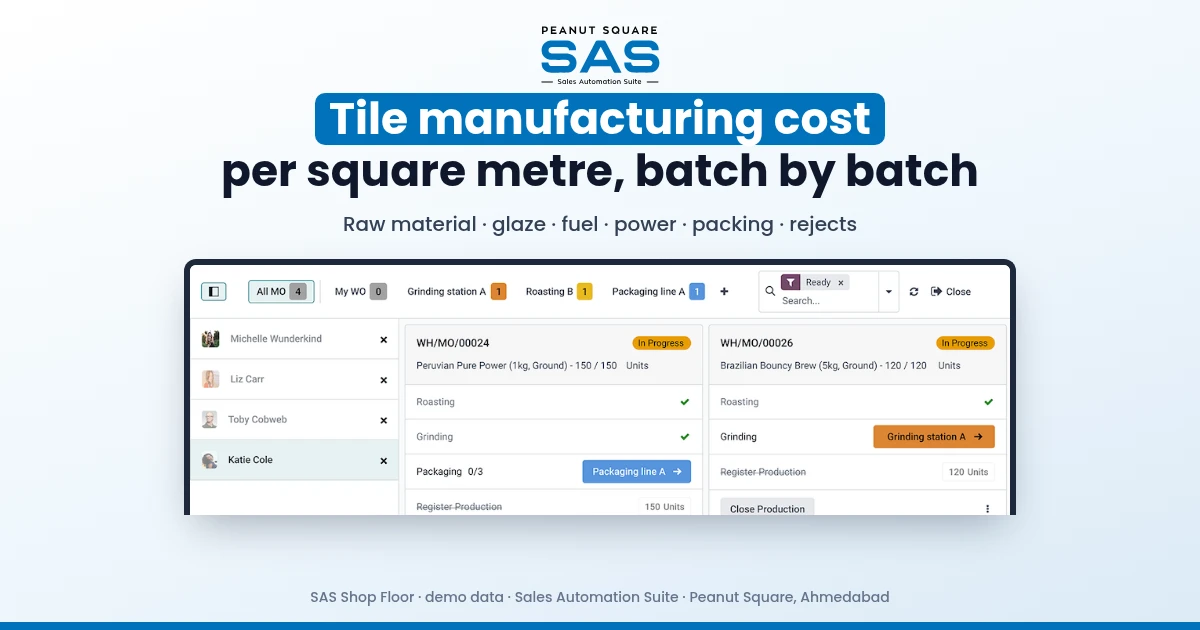
An ERP helps when the batch, the material issued and the output sit on one record. SAS lists BOM, Production Jobs, Material Issue, Consumption, WIP Stage Movement, Backflush, Rejection Analysis and Batches among its operations features, with Purchase Orders, GRN and Stock Reconciliation on the buying side. The SAS Manufacturing page describes manufacturing orders with component availability and cost control.
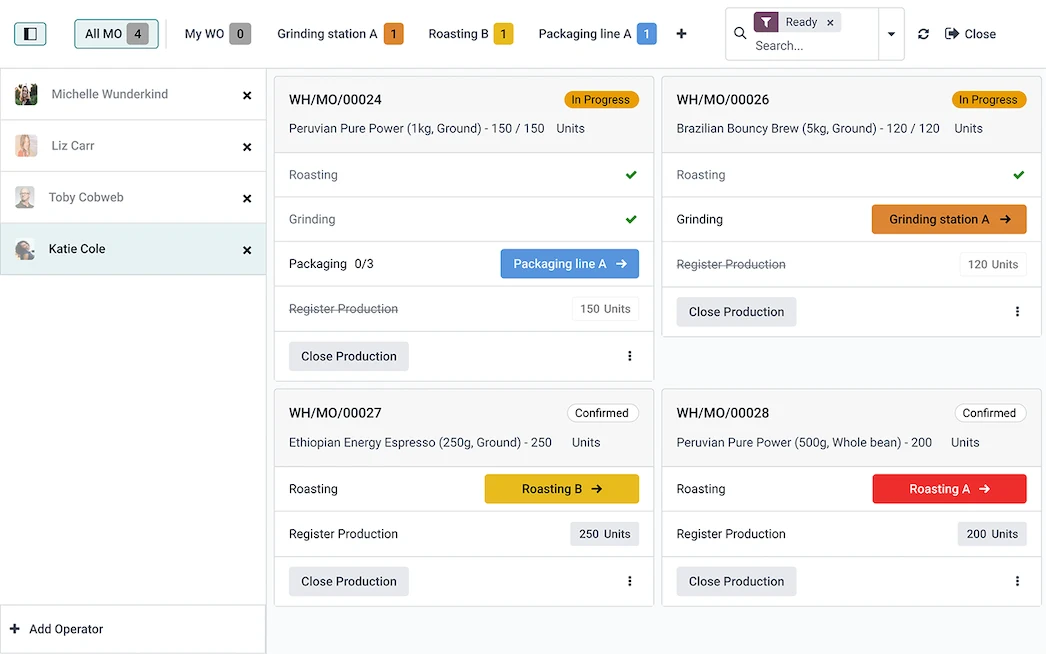
Manufacturing orders on the SAS Shop Floor screen, with production registered step by step. Demo data from the sample company.
On the accounts side, Vouchers, Ledger Record and the Trial Balance hold the money, and the BI Dashboard and Excel export let you pull the numbers into your own cost sheet.
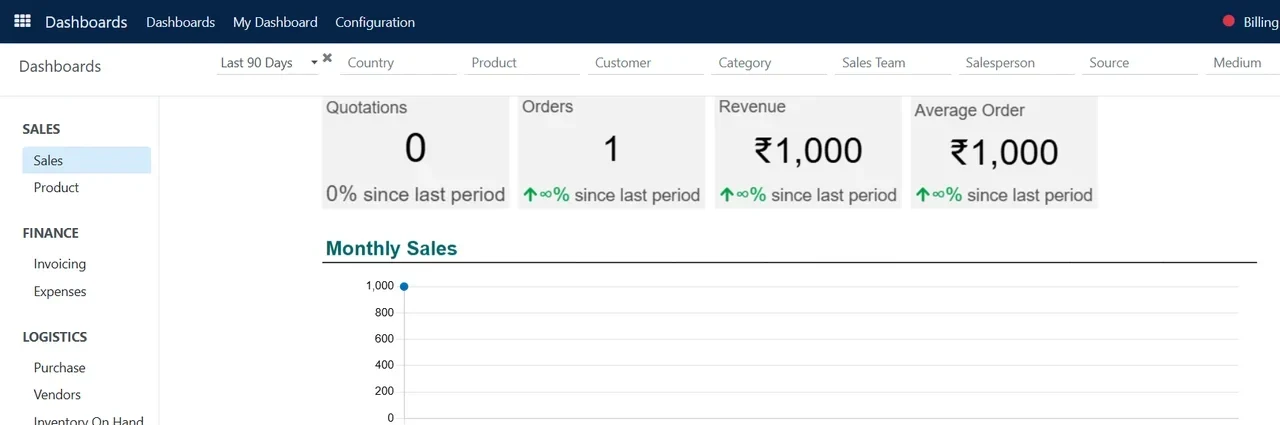
The SAS dashboard groups sales, finance and logistics views. Demo data.
For the stock side, read ceramic stock management by design, batch and grade, and for the planning side, tile production planning from dealer orders. The ceramic industry ERP and CRM guide covers the wider system. Bring one real batch cost sheet to the demo and ask how each line maps to your own items.
What does SAS cost?
₹300/user/month on Premium (40% off ₹500, GST extra, billed yearly). Enterprise has custom pricing, tailored to your business requirements. Both plans include the full feature set, email support is always free, and 20 minutes of phone support is included each month. See the pricing page. Sales Automation Suite is built by Peanut Square LLP in Ahmedabad.
FAQ
How is tile manufacturing cost per square metre calculated?
Add every cost booked to one batch, from raw material, glaze, fuel and power to packing, labour and overheads, then divide by the saleable square metres that batch produced.
Which cost is largest in a tile factory?
Raw material and energy are usually the two biggest heads. A Bureau of Energy Efficiency manual from April 2010 put energy at about 25% to 30% of production cost in the Morbi cluster.
Should rejects be included in the cost?
Yes. Their cost stays in the batch total, but they are left out of the saleable square metres, so a batch with more rejects shows a higher cost per square metre.
How much does SAS cost per user?
₹300/user/month on Premium (40% off ₹500, GST extra, billed yearly). Enterprise has custom pricing.
Is there a free trial of SAS?
No. You can book a free demo at sas.peanutsquare.com and walk through one of your own batches with the team.
See your own batch costs in one place: Book a free demo at sas.peanutsquare.com.
Sources: Manual on Energy Conservation Measures in Ceramic Cluster Morbi, Bureau of Energy Efficiency, April 2010, read 29 November 2026; SAS Manufacturing page and SAS pricing page (features list), read 29 November 2026. The worked example uses made-up round numbers, not industry figures. Screens show demo data.